
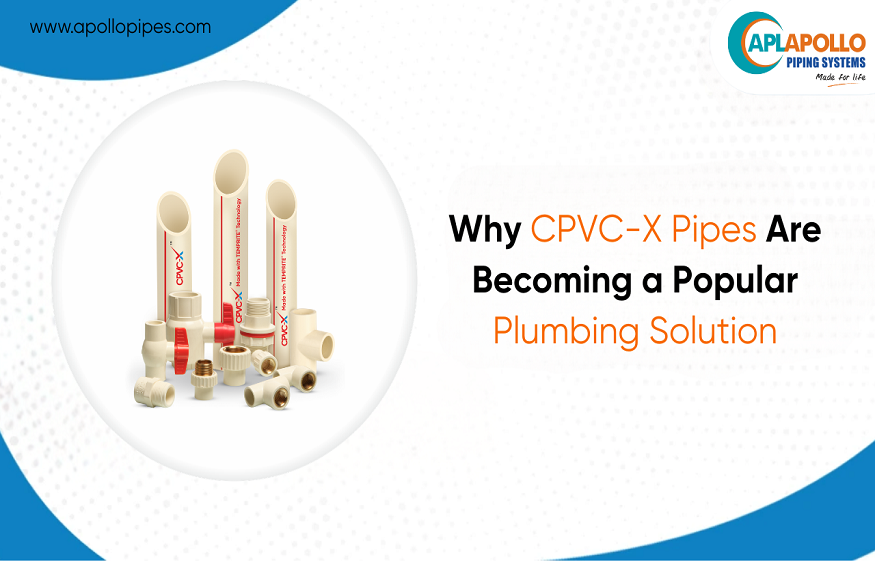
Why CPVC-X Pipes Are Becoming a Popular Plumbing Solution
Modern plumbing systems need to deliver water safely and efficiently while handling the demands of everyday use. From residential buildings and offices to commercial facilities and industrial installations, the choice of plumbing pipes can influence durability, maintenance, water flow, and installation requirements. As a result, CPVC-based systems are increasingly being considered for hot- and cold-water distribution. CPVC-X pipes, a CPVC-based plumbing solution, combine properties such as strength, temperature resistance, smooth internal surfaces, and practical installation methods, making them relevant for a range of modern plumbing applications.
What Are CPVC-X Pipes?
CPVC stands for Chlorinated Polyvinyl Chloride, a thermoplastic material used in plumbing and water-distribution systems. CPVC-X pipes are designed for applications involving hot and cold water, with the material offering resistance to elevated temperatures and corrosion.
Unlike some traditional plumbing materials, CPVC systems do not depend on metal components throughout the pipe network. Their compatibility with solvent-welded connections also allows pipes and CPVC fittings to be joined to create a continuous plumbing system. Depending on the product and manufacturer, CPVC-X systems may be suitable for potable-water distribution as well as specified industrial applications.
Why Are CPVC-X Pipes Becoming Popular?
1. Strength and Durability
A plumbing system is expected to remain dependable under regular operating conditions for years. CPVC-X pipes are designed to provide strength and durability while remaining relatively lightweight. This combination can be useful in residential, commercial, and industrial projects where both reliable performance and practical handling are important.
2. Resistance to High Temperatures
Hot-water plumbing places additional demands on pipe materials. CPVC is designed to handle elevated temperatures, making CPVC-X systems suitable for applications involving hot as well as cold water. However, the allowable temperature and pressure conditions should always be checked against the specific product’s technical specifications.
3. Smooth Internal Surfaces for Efficient Flow
The internal surface of a pipe influences how easily water moves through a plumbing network. CPVC-X pipes with smooth internal surfaces can minimise friction and pressure loss, supporting efficient water flow. This characteristic is particularly useful when designing systems where consistent water delivery is important.
4. Corrosion and Chemical Resistance
Corrosion can be a concern with certain plumbing materials, particularly in environments where water or chemicals can affect the pipe material. CPVC systems offer resistance to corrosion and can also provide resistance to various chemicals. This makes them relevant for selected plumbing and industrial-fluid applications, subject to compatibility requirements.
5. Leak-Resistant Connections
The performance of a plumbing system depends not only on the pipes but also on the quality of its joints. CPVC-X systems commonly use solvent-welded connections, where compatible solvent cement creates a secure connection between the pipe and fitting. When installed correctly according to manufacturer instructions, these joints can provide a reliable and leak-resistant plumbing network.
6. Easy Installation and Handling
Installation efficiency is another consideration for plumbers and contractors. CPVC pipes are lightweight compared with many conventional pipe materials and can be cut and joined using suitable tools and solvent-cementing methods. Their relatively simple handling can help make installation more practical, particularly across projects with extensive piping networks.
Read More: Install new windows to save energy
7. Hygiene and Potable-Water Applications
Water intended for household consumption requires appropriate plumbing materials and installation practices. CPVC-X systems designed and certified for potable-water applications can be used for hot and cold water distribution. The material’s resistance to corrosion also helps avoid issues associated with corrosion of metallic pipework. Product certification and manufacturer specifications should always be checked before use in potable-water systems.
8. Versatility Across Plumbing Projects
The combination of temperature resistance, durability, smooth flow characteristics, and practical installation makes CPVCX pipes suitable for consideration across different project types. In residential buildings, they can be used for hot and cold water plumbing. Commercial buildings may use CPVC-based systems for water distribution, while certain industrial applications can use appropriately specified systems for industrial fluids.
What to Consider When Choosing CPVC-X Pipes?
Selecting plumbing pipes should begin with the requirements of the application rather than simply the material name. Consider the required pipe diameter, operating pressure, temperature conditions, water or fluid being transported, applicable standards, and installation method. The compatibility of CPVC fittings, solvent cement, valves, and other components should also be checked.
It is equally important to select products manufactured according to relevant standards and to follow the manufacturer’s installation guidelines. Product specifications can vary between systems, so technical information should be reviewed before final selection.
Read More: 8 tips to know to light up your interior
APL Apollo CPVC-X Extra Strong Plumbing System
APL Apollo CPVC-X Extra Strong Plumbing System uses TEMPRITE® CPVC Resin from Lubrizol, which APL Apollo states provides extra strength and temperature resistance of up to 93°C.
The system is designed for transporting hot and cold potable water as well as certain industrial fluids and is stated to withstand 2000 PSI stress. Its smooth inner surfaces are designed to minimise friction and pressure loss and support efficient water flow, while solvent-welded joints provide strong, secure and leak-proof connections.
The CPVC pipes are lightweight and can be cut, joined and installed using solvent-cementing methods. APL Apollo lists features including superior heat resistance, chlorine and chemical resistance, smooth-flow hydraulics, durability, solvent-welded joints and low bacterial growth.
The system is stated to be ISI certified, with pipe standard IS 15778 and fitting standard IS 17546, and its listed standards include ASTM D1784, ASTM D2846/IS 15778, ASTM F493, ASTM F441, ASTM F438 and ASTM F439. Available pipe sizes include SDR 11 and SDR 13.5 from ½ inch (15 mm) to 2 inches (50 mm), and SCH 40 and SCH 80 from 2½ inches (65 mm) to 4 inches (100 mm).
